

One of the simplest strategies to make sure all of your money is working for you is also one of the most commonly missed.
When creating a financial plan with a client, I always ask whether they have established an emergency fund, where it is held, and what interest rate it is earning. For those who have built one up, it is commonly held in a traditional checking or savings account earning next to no interest. With minimal time and effort, these clients can increase the return on their emergency fund by three hundred times or more by using a high-yield savings account or money market mutual fund.
One individual I work with is retired and financially secure, living primarily off pension and Social Security income. She prefers to hold a higher-than-typical emergency fund (usually we advise keeping about 12 months’ worth of withdrawal needs), and that is perfectly reasonable, since peace of mind is a real and important factor. However, she had been holding this balance at a large national bank in checking and savings accounts earning only 0.01% and 0.10% per year, respectively. On a $150,000 balance, the savings account was paying her $15 per year in interest. I encouraged her to use a money market mutual fund or high-yield savings account, both of which can offer about 3%-4% at current rates. She is now using both, with the bulk going into her high-yield savings account for the convenience of deposits and withdrawals. Instead of earning $15 per year, she now expects to earn about $4,875.
A couple I work with has a cash management account at Fidelity — a convenient way to receive withdrawals from their investments into a self-managed account that is readily available for expenses. This can be a great place for an emergency fund, but there was room for improvement due to a default setting that can be easily overlooked. Fidelity typically offers two options for where cash lands: one called “FCASH” or “Fidelity Cash,” which currently yields about 1.8% per year, and a Fidelity government money market fund (SPAXX), which yields about 3.3% — but you have to actively select it. I helped them make the switch, increasing their annual return by approximately 1.5 percentage points, or an additional $1,500 per year on a $100,000 balance.
When choosing where to hold your emergency fund, you should understand the timeline for withdrawing, the risks (FDIC insurance on bank accounts versus investment risk on money market mutual funds), ease of deposits and withdrawals, interest rates, and any fees and penalties.
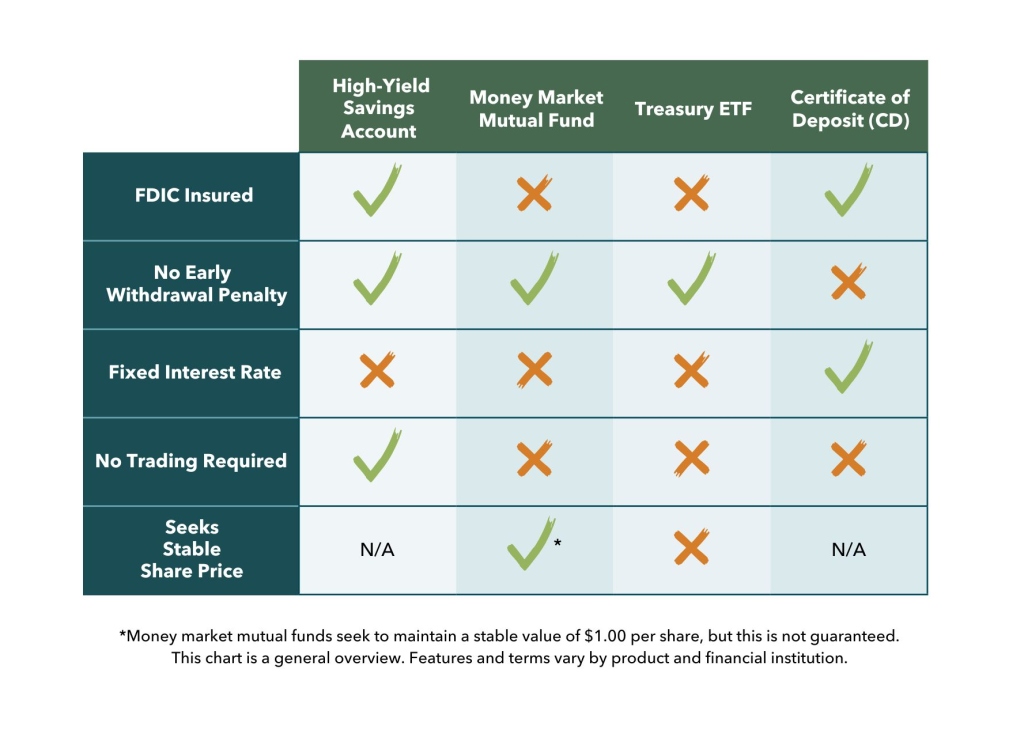
For many people, a high-yield savings account is a great option because it retains the convenience and FDIC insurance of a traditional savings account while offering a much higher return. Many online banks offer competitive rates, no account fees, no minimum balance requirement, and no withdrawal limits.
Money market mutual funds are an investment that you must buy and sell when adding or withdrawing money. Not all funds are created equally — some contain strictly government securities, while others have some higher-risk features that would not be appropriate for an emergency fund. All of these funds seek to maintain a stable value of $1.00 per share, but this is not guaranteed, and they are not FDIC-insured. They also have investment expenses which you should examine before purchasing. With this added complexity comes a yield that is typically a bit higher than a high-yield savings account.
There are also exchange traded funds (ETFs) that contain short-term treasury securities, many with lower expenses and competitive yields compared to money market funds. However, because they are ETFs, the fund value changes throughout the day and month as the dividend date approaches — it can be unsettling for some people to observe the share price of their emergency fund fluctuate, regardless of the safety of the underlying treasuries.
Certificates of Deposit (CDs) are another commonly encountered option. While they often offer competitive yields and FDIC insurance, many come with early withdrawal penalties, making them a poor fit for an emergency fund where quick and penalty-free access is essential.
Some people may never need their emergency fund and it becomes a true set-it-and-forget-it account. Others will be glad they saved when a major expense arrives. All will be grateful to earn a competitive return along the way.